A low floor and a wide side opening
The N-VAN offers access for bulky loads through the passenger side and can use the front passenger-seat area as cargo space. Its front-wheel-drive-based design and centre tank layout, with the fuel tank beneath the front seats, allow a low cargo floor. Opening both passenger-side doors creates a large opening as an alternative to the tailgate.
This guide covers petrol JJ1/JJ2 models: JJ1 is FF and JJ2 4WD. The electric N-VAN e: has different power, charging and seating considerations and is not mixed into this guide. Compare where you load and how many people travel, not just cargo volume.
Single-driver convenience and passenger conditions
- Wide passenger-side loading access and a low lifting height.
- Folding the passenger and rear seats accommodates long items.
- CVT/6MT and naturally aspirated/turbo choices depend on year and grade.
- Maximum load length with the passenger seat folded is different from usable length with a passenger seated.
- Check the comfort of every seat you will use, not only the driver’s seat.
- The large side opening needs room beside the van for the front passenger door.
- Payload and driver-assistance features vary by drivetrain, occupants and transmission.
When carrying people regularly, check the seat cushions, backrests, foot space and entry/exit in the actual van. Being able to seat four is different from four people travelling comfortably for a long time. These are iWorks’ practical suggestions, not statistical superiority or reliability claims.
Equipment changes within the JJ generation
| Announcement | Change | Used-vehicle check |
|---|---|---|
| July 2018 | Launch with G, L and +STYLE variants, CVT and 6MT. | Some versions did not have Honda SENSING; a grade name alone is insufficient. |
| February 2021 | Honda SENSING became standard on all grades; auto lights/auto high beam added to G/L. | Some assistance functions are absent on 6MT; do not use the CVT feature list. |
| April 2024 | Sudden-acceleration suppression added to FUN CVT, STYLE+ NATURE special edition, 6MT offered on G/FUN. | Check older availability when looking for L 6MT and the activation settings of acceleration suppression. |
| March 2026 | 7-inch TFT meter and other changes; push-button engine start and other features added to G/L. | Do not assume older G/L models have newer standard equipment. |
These are selected changes. Distinguish announcement, launch, production and registration dates. Honda SENSING functions vary with year, specification and transmission.
G, L, FUN and earlier +STYLE versions
Use the catalogue for the relevant year. Earlier +STYLE FUN/+STYLE COOL, later FUN and special editions are not identical specifications.
| Grade | Check | Consider |
|---|---|---|
| G | Key/start operation, windows, mirrors, assistance features and CVT/6MT. | Necessary equipment, condition and total cost. |
| L | Comfort equipment, year changes and transmission choices. | Frequently used work equipment and the driver’s preferences. |
| +STYLE FUN / FUN | Exterior, lamps, interior and year-specific smart-key equipment. | Work and hobbies; aftermarket accessories are not automatically standard. |
| +STYLE COOL | Original roof, styling, equipment and actual cargo height. | Check height and fit against other versions. |
| Turbo / special editions | Engine, transmission, dedicated equipment and accessories. | Roads, loads, price and maintenance history. |
At launch, the manufacturer stated that 6MT lacked ACC, LKAS and certain other assistance functions such as unintended-start suppression. The sudden-acceleration suppression introduced in 2024 applies to specific types and requires operating settings to be enabled. Check both fitment and whether it is available for use. This table is a checklist, not a universal equipment specification.
Choose engine and transmission together
Petrol N-VAN choices include naturally aspirated and turbo engines, CVT and 6MT, but not every combination is offered in every grade. The 2021 +STYLE FUN Turbo and 2024 FUN Turbo were not offered with 6MT.
| Choice | How to assess it | Before purchase |
|---|---|---|
| Naturally aspirated | Whether performance is sufficient for city and routine use. | Discuss loaded take-off, hills and motorway driving. |
| Turbo | Required performance with loads and gradients. | Check history, total cost and fuel use; turbo is not best for everyone. |
| CVT | Continuously variable transmission without clutch operation. | Check low-speed response, condition and year-specific assistance. |
| 6MT | Six-speed manual with driver-operated clutch and shifting. | Consider traffic/repeated stops and assistance differences from CVT. |
Compare fuel economy for the correct year, FF/4WD, engine and transmission. Do not directly compare JC08 with WLTC or treat catalogue values as guaranteed actual economy. Include city/suburban/motorway use, fuel, tyres, regular checks and future maintenance. Manual transmission does not always mean better economy, and N-VAN is not automatically cheaper to maintain than another vehicle.
Will the front passenger seat be in use?
With the passenger-side doors open and passenger/rear seats folded, loading extends forward. The additional length created by folding the passenger seat is not available when that seat is occupied.
| Use | Cargo space to check | Important condition |
|---|---|---|
| One person and long items | Space with passenger/rear seats folded and load securing. | Keep visibility and controls clear; use the correct folding procedure. |
| Driver and front passenger | Space with both front seats in use. | Do not plan around maximum single-driver cargo space. |
| Rear-seat passengers | Space with all required seats in use. | The 2025 owner’s manual prohibits rear-seat occupancy with the front passenger seat folded. |
The manufacturer specifications referenced by the Japanese guide state 350 kg with two occupants for FF, 300 kg for 4WD and 200 kg with four occupants. Check the actual vehicle’s inspection certificate and specifications; do not assume all kei vans carry 350 kg.
Check side-door clearance, load shape, shelves/flooring and tie-downs. Compare with Every or Hijet using the same people, load and seat arrangement.
Inspect access and future maintenance
N-VAN’s engine compartment is accessed through the front bonnet. Honda’s 2019 and 2025 manuals also direct owners to open the bonnet when checking a flat battery. Confirm bonnet operation and routine inspection points, and discuss upcoming oil, battery and tyre work. Access alone does not make every repair easy or inexpensive.
Use the correct year’s owner’s manual for assistance and battery connections. This guide does not extract only part of a jump-start procedure. If uncertain, contact a workshop or roadside service. iWorks covers Aichi on operating days during business hours, subject to availability.
Engine oil, CVT/manual-transmission fluids and batteries must match the year and specification. We do not assert unverified failure rates or common faults.
Check the seats and doors as well as the engine
- Passenger/rear seat folding, return, locking and required parts such as headrests.
- Passenger-side door opening/closing, locking, fit and sliding-door movement.
- Cargo-floor damage, securing hooks and shelving/floor attachments.
- Comfort of every seat that will be used.
- Actual CVT/6MT condition and clutch operation.
- Service records, fluid changes, repairs and upcoming work.
- Year-correct driver assistance, warning lights and settings.
- Total price, included maintenance and warranty coverage, period and conditions.
Check whether accessories interfere with seats, doors, visibility or safety equipment. Verify structural repair history, underbody condition and recalls using explanations and the chassis number. These are purchase checks, not claims of model-specific failures.
Choose around loading and passengers
| Use | Focus | Suggestion |
|---|---|---|
| Solo deliveries / visits | Side loading, entry/exit and daily distance. | Try the cases and goods you actually carry. |
| Equipment / service work | Long items, tools, shelves and securing. | Include days when the passenger seat is occupied. |
| Two or more people | Passenger/rear-seat comfort and remaining cargo area. | Sit in the seats you will use and compare other vans. |
| Motorways / hills | Turbo need, transmission and year-specific assistance. | Discuss normal loads, performance and cost together. |
| Hobbies / outdoor | Equipment, sleeping layouts, occupants and everyday use. | Check seat operation and where to store your load. |
| Payload priority | FF/4WD, occupants and conversions. | Consider weight separately from shape; verify the certificate. |
Choose 4WD with regard to roads, season, tyres, loads and costs; outdoor use alone does not make it necessary.
Find a van that fits your work
iWorks is a kei van specialist in Midori Ward, Nagoya. We can help you compare the Suzuki Every, Daihatsu Hijet Cargo and Honda N-VAN, with advice from both vehicle sales and our certified maintenance workshop. Some vehicles are not listed online. Tell us your budget, preferred model year, mileage, transmission, equipment and the loads you carry.
Browse our stock on Goo-net (Japanese) · Contact us on LINE · Call 052-602-7204
The stock link covers the whole dealership, not just this model. Check the individual listing or contact us for current availability.
Sales office: 10:00–18:00, closed Sundays and Mondays that fall on public holidays. Workshop: 9:00–17:00, closed Saturdays, Sundays and public holidays.
Official reference material
These are the references used for the Japanese guide. Match the documents to the model year and grade of the actual vehicle. Manufacturer announcements, production dates and registration dates are not interchangeable.
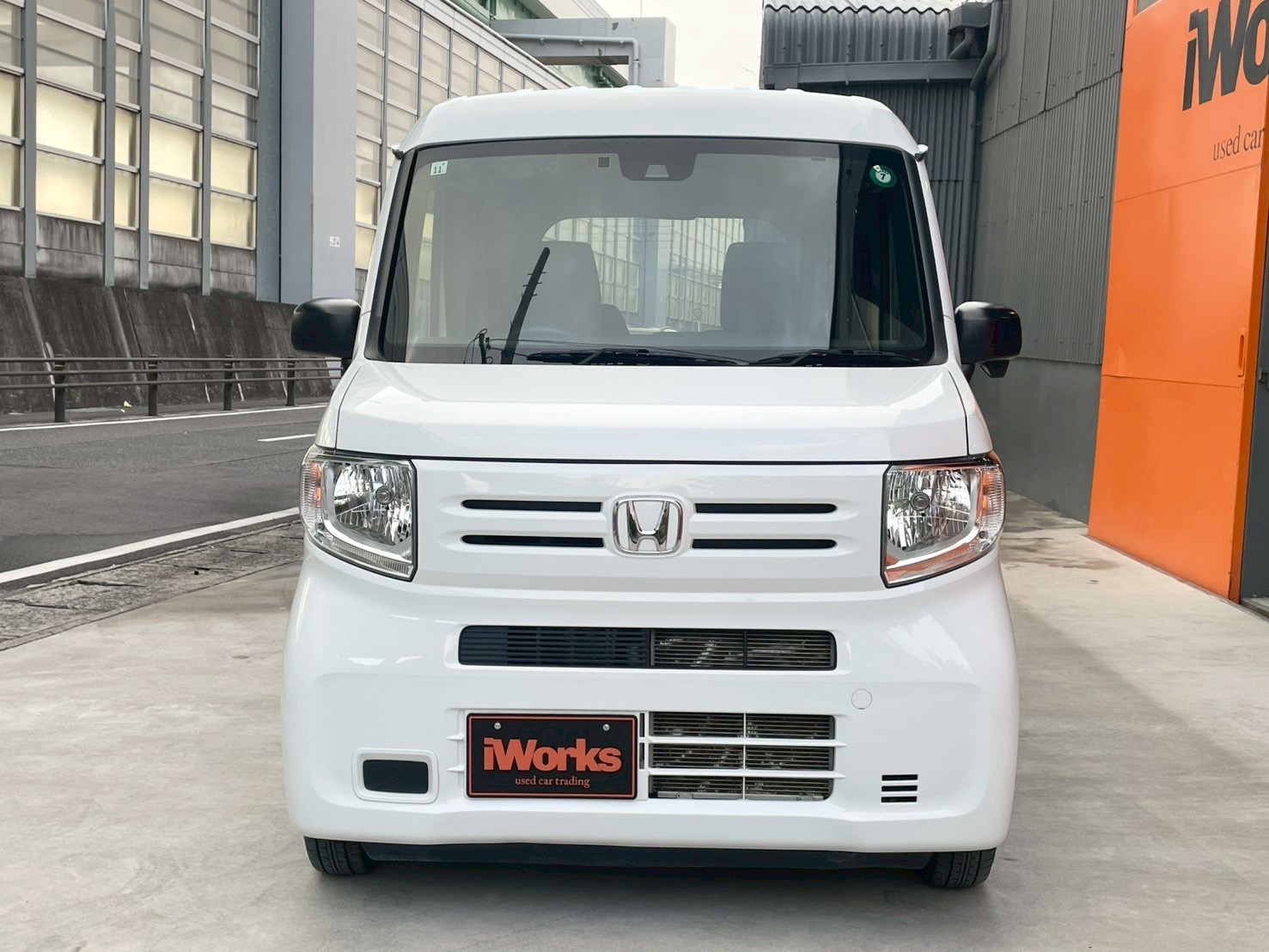
Vehicle examples with edited backgrounds. Check the individual listing or ask iWorks for the actual model year, equipment and current availability.
iWorks REAL CAR GUIDE
N-VAN: exterior and cargo photographs.
How many people will travel? What will you carry?
Compare the same seat arrangements to find the space you need.
Camera positions and angles differ. Do not judge dimensions from apparent size alone. Look at floor shape, side intrusions and how the cargo area connects to the seats.
First identify the model
Below, compare its cargo area with each seat arrangement.
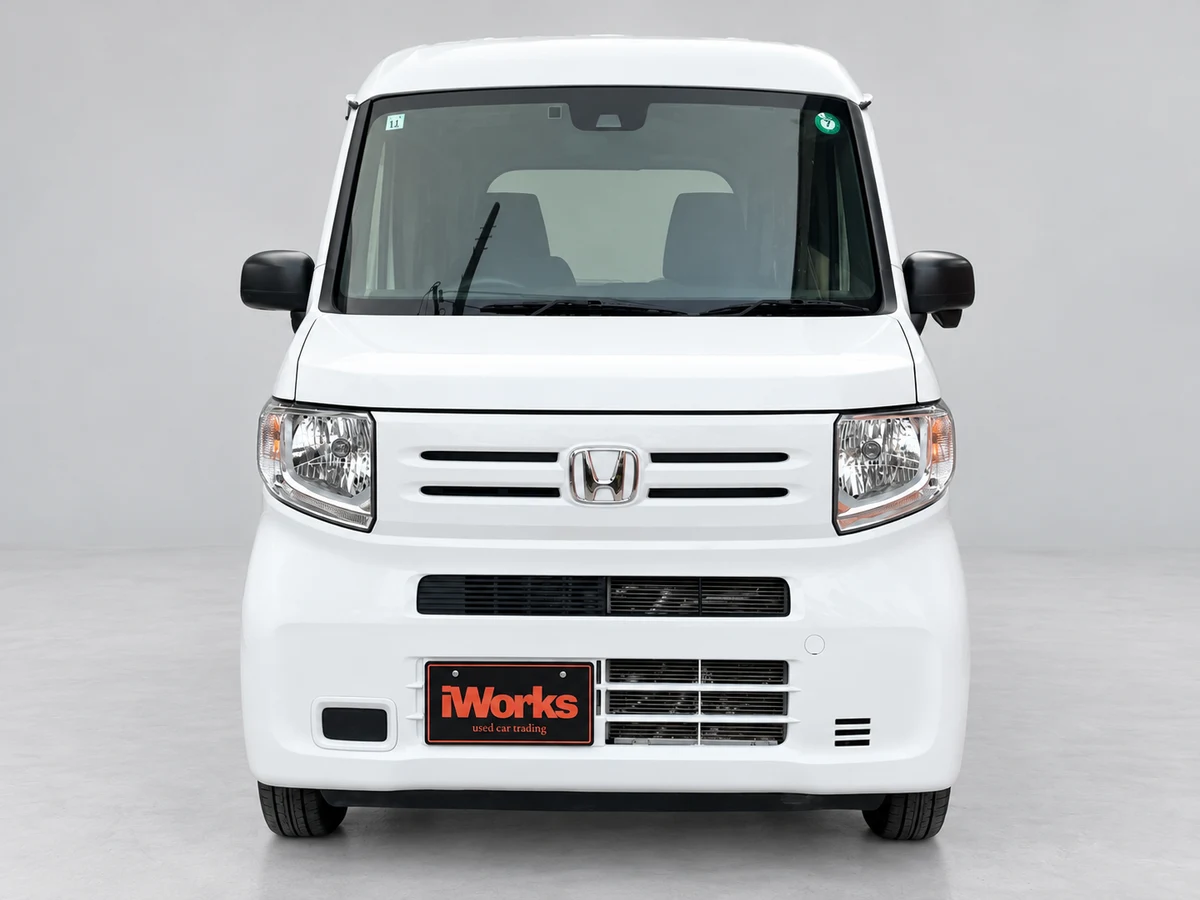 Enlarge photo +
An example of a vehicle handled by iWorks
Background and brightness adjusted for presentation
View the original photograph
What remains with the rear seats in use?
Rear seats in use | Cargo space while carrying passengers
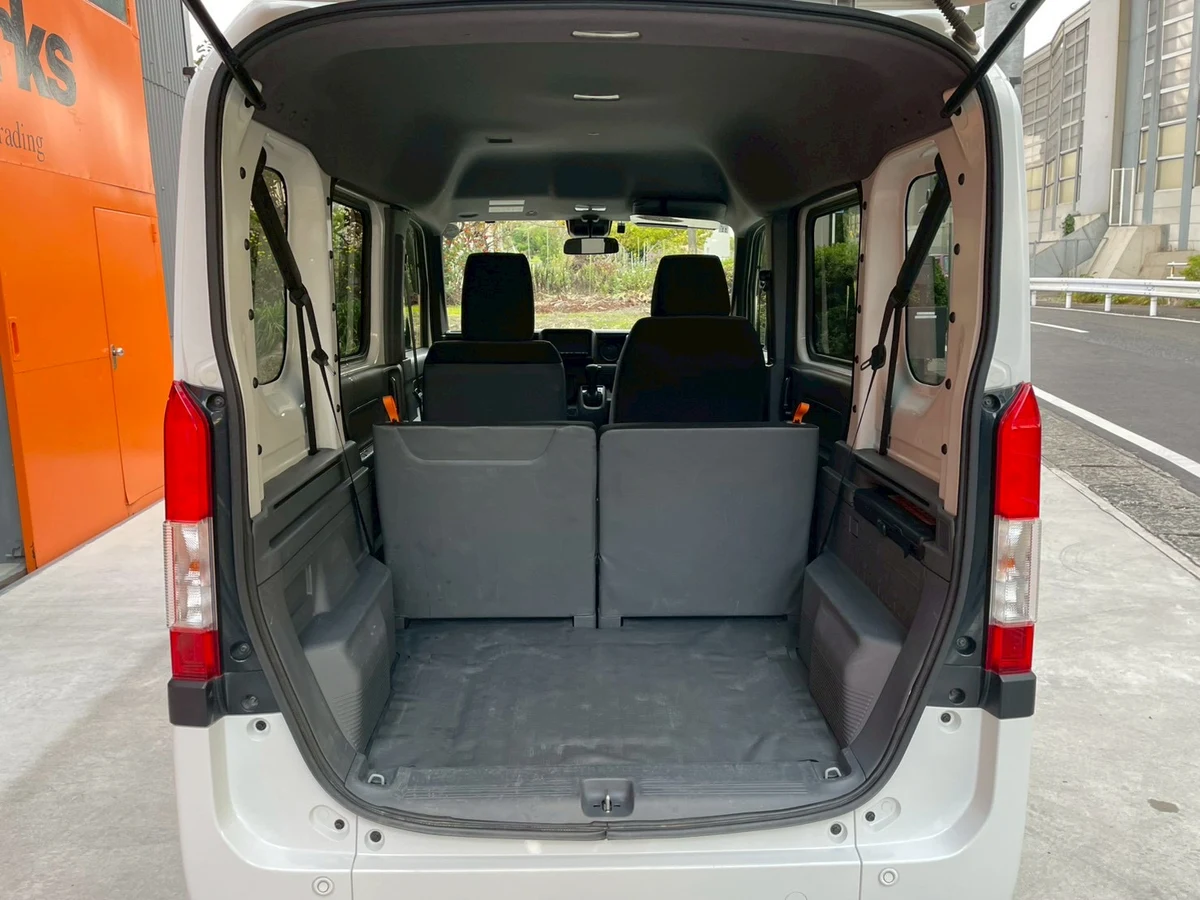 Enlarge photo +
Both rear seats are upright. Check the space behind their backrests.
Look for the depth from the rear backrests to the cargo opening. Picture where your usual shopping bags or toolboxes would go.
Fold the rear seats for cargo
Rear seats folded · passenger seat available | Compare with both front seats usable
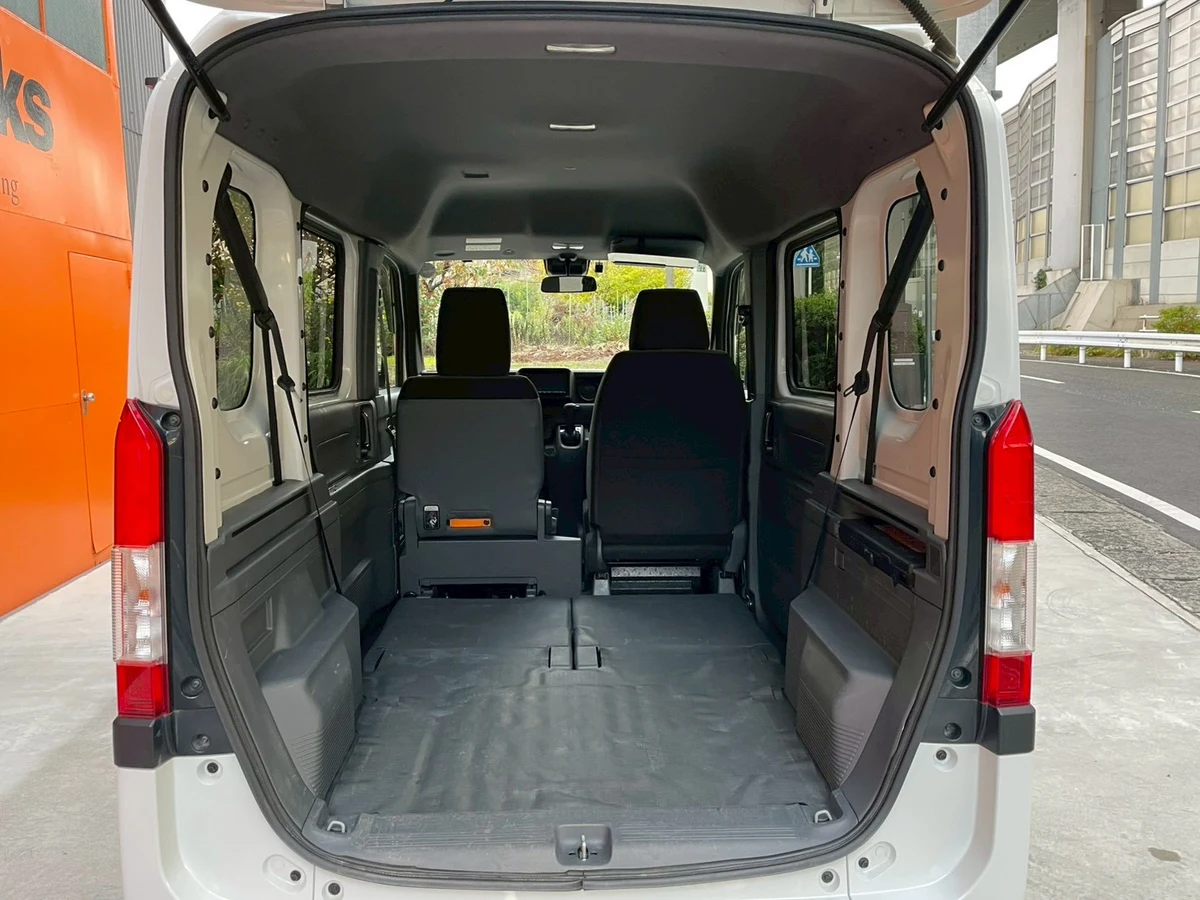 Enlarge photo +
The front passenger seat remains available. Check the floor behind both front seats.
Look for floor width, side intrusions, steps and the usable area behind the front seats.
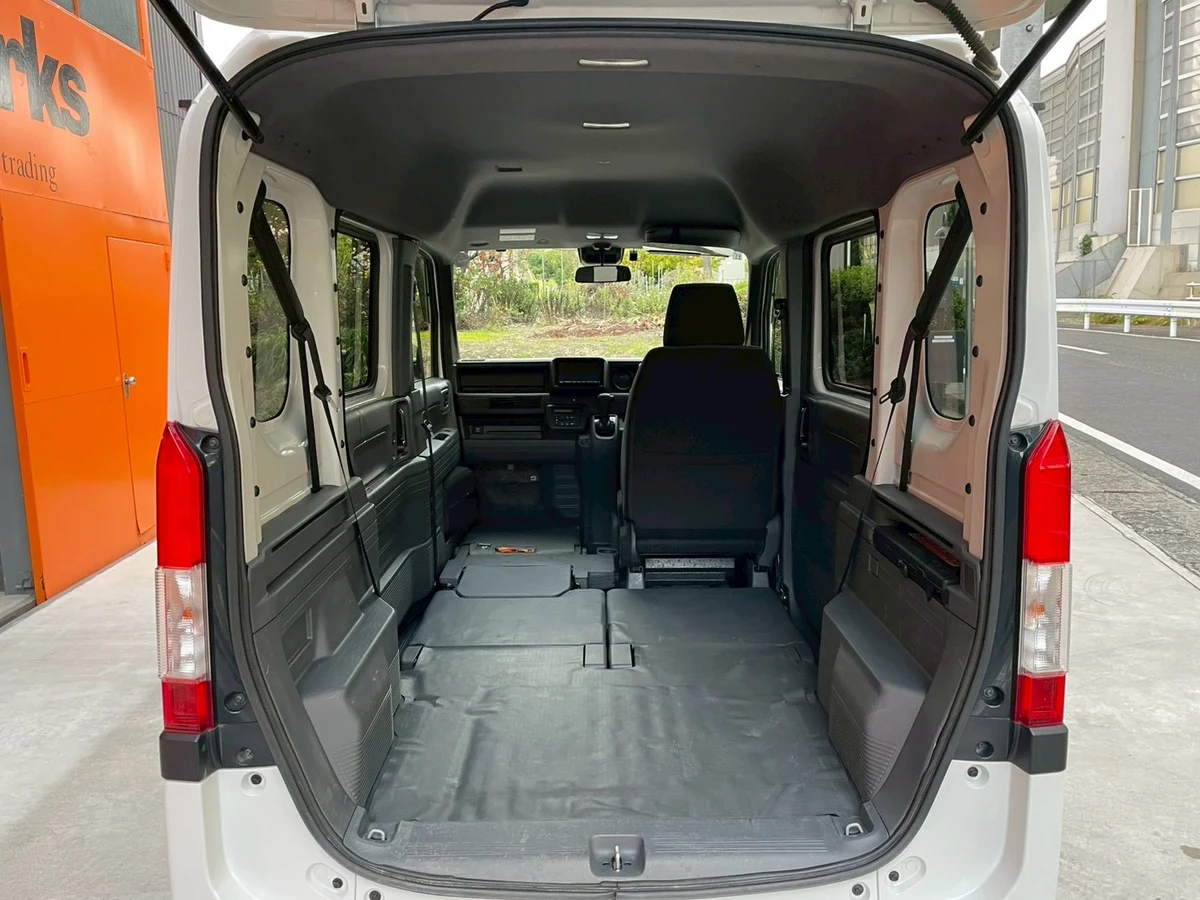
N-VAN: use the passenger side for extra length
Passenger and rear seats folded | An additional arrangement for driver-only use
 Enlarge photo +
Driver only. The load space extends along the front passenger side.
For long items,
check the passenger-side space.
This photograph has the front passenger seat folded as well as the rear seats. The number of occupants and the use of the cargo area differ from the two-front-seat comparison above.
If you carry stepladders or long tools, tell us their length, width and height so we can check whether they fit the actual vehicle.
Check fit using your load’s actual dimensions.
Cargo space and seat-folding arrangements vary by year, grade and equipment. On the candidate vehicle, check opening width and height, floor width and depth, and any steps.
Photographs: examples of vehicles handled by iWorks; not a guarantee of current stock. Exterior images have adjusted backgrounds or brightness, and original photographs are available. Cargo images are real photographs without alterations to shape, steps or seat layout.
SIZE & SPACE
N-VAN dimensions: separate two-person and driver-only use
Similar body sizes do not mean identical usable cargo space. Compare common used models with their specification and seat configuration clearly stated.
Body and cargo dimensions are shown separately. Cargo widths with four occupants and maximum lengths with the front passenger seat folded are not mixed into this comparison. Figures are published by the manufacturers, not measured by iWorks.
JJ1
N-VAN
L Honda SENSING / FF / high roof
Model introduced July 2018, discontinued January 2021
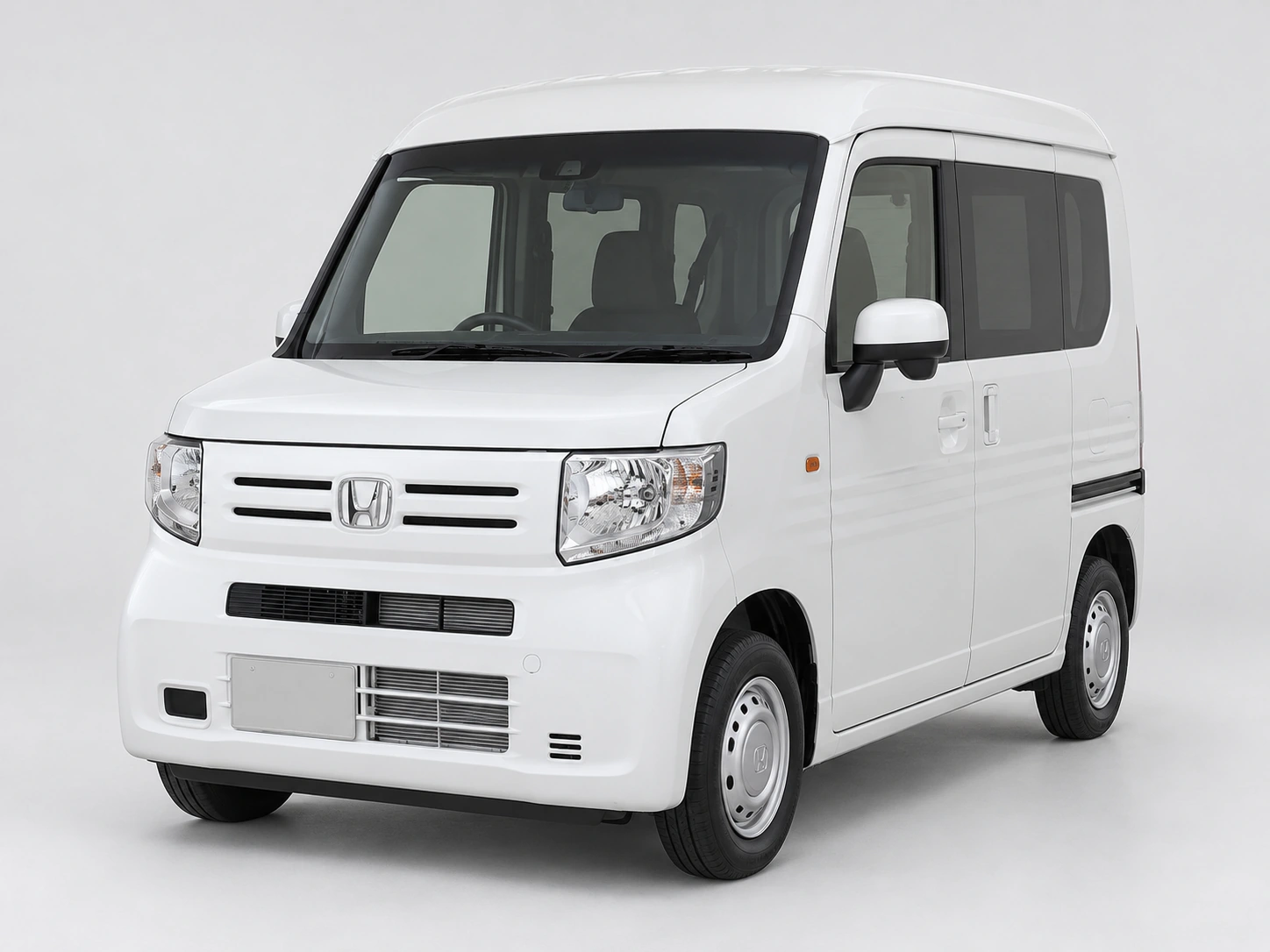
Original photographed 27 July 2018. Photograph:Tokumeigakarinoaoshima / Wikimedia Commons original / CC BY-SA 4.0. Background, framing and lighting adjusted with AI; display items and signs removed. Use the tables and diagrams for dimensions.
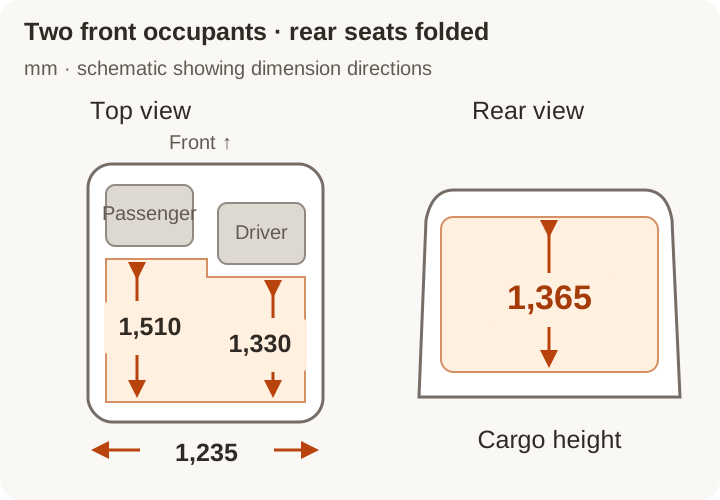
Cargo dimensions: two front occupants, rear seats folded / mm
- Cargo length
- 1,510Passenger side / driver side: 1,330
- Cargo width
- 1,235
- Cargo height
- 1,365
Body length × width × height:3,395 × 1,475 × 1,945 mm
With two occupants, cargo length is 1,510 mm on the passenger side and 1,330 mm on the driver side. If a 1,365 mm cargo height and low floor suit your work, also check loading and unloading with your actual cargo.
The maximum space length of 2,635 mm, with the passenger seat also folded, is a driver-only measurement on the passenger side. It is a different condition from the cargo length with two occupants.
The 1,945 mm body height shown is for FF high-roof versions. The 4WD height is 1,960 mm; the period’s +STYLE COOL has a low roof and different cargo dimensions.
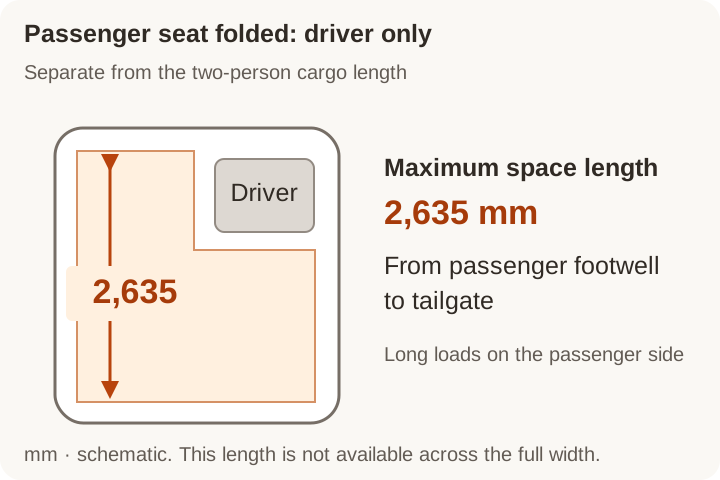
The 2,635 mm figure is Honda’s measurement from the passenger footwell to the tailgate. Check load width and thickness, and any interference with the driving seat.
Dimension sources (Japanese):Honda: specifications for the model introduced in 2018
Honda: cargo area and storage, model introduced in 2018
Cargo length, width and height are measurements in each direction from the specification sheet. The same width and height are not available everywhere, and measurement points differ between models. Check floor length, openings and the narrowest points separately.
Sources and images checked: 28 October 2026. Exterior images illustrate the models. Manufacturer photographs and dimension drawings have not been reproduced; the explanatory diagrams were created from published figures. Archived copies of the original manufacturer PDFs were also used for older specifications.