
Japanese source reviewed as of 21 October 2026. This guide is for people starting a new light-freight transport business in Aichi Prefecture.
1. What is a black number plate?
A black plate with yellow characters identifies a kei vehicle used for business. When starting a service carrying other people’s goods for payment, you generally need to notify the authorities of a light-freight transport business and change the vehicle to business use. An individual can start with one vehicle.
Carrying only your own products or work tools does not automatically require a black plate. The answer depends on the cargo, contract and payment arrangements; ask the transport branch office if unsure.
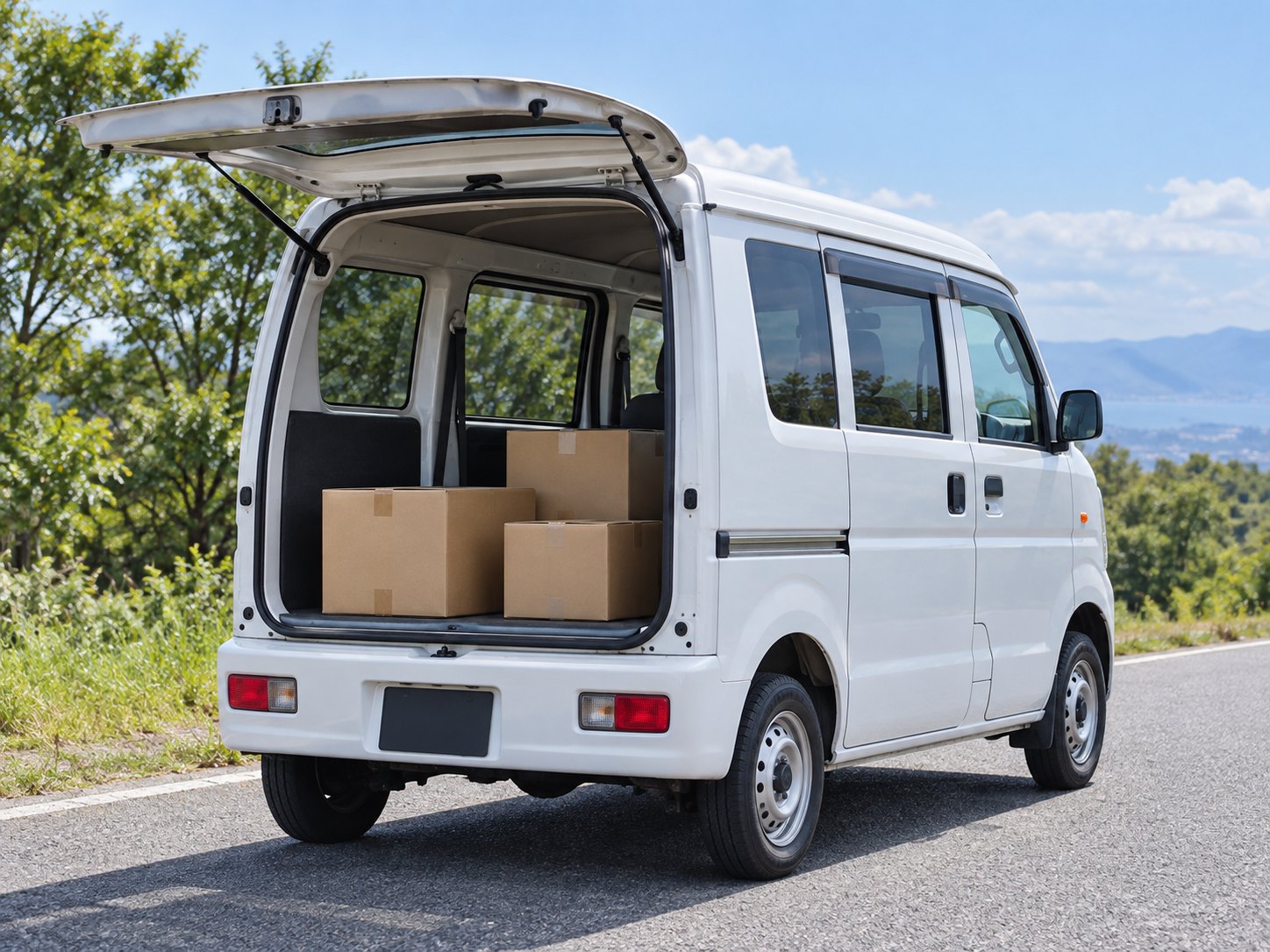
The example here: a privately used kei goods vehicle with a valid inspection, being changed to business use for a new business in Aichi. New vehicles, expired inspections, owner/user changes and use of a kei passenger car may require different documents or inspections.
- Prepare the vehicle, office and parking, and book training or other appointments.
- Notify the Aichi Transport Branch Office and receive the business-vehicle liaison document.
- Complete the business-use change at the responsible Light Motor Vehicle Inspection Organization office and receive black plates.
- Finish safety-management and insurance preparations before starting operations.
2. What to prepare first
- A suitable kei van: check load size/weight, access and maximum payload on the inspection certificate.
- Business office: a base for business and driver management; a home may qualify if the conditions are met.
- Parking: normally at the office. Aichi guidance allows a location within 2 km when adjacent parking is unavailable; ensure space for all vehicles, legal usage rights and compliance with applicable rules.
- Rest facilities: a place drivers can use effectively; check conditions even when using a home.
- Owner’s consent: where a finance or lease company is the registered owner, confirm consent and documents before proceeding.
- Fares, charges and conditions of carriage: prepare them for your business.
- Training and aptitude-test bookings: availability can take time, so organise these alongside registration.
3. Notify the Aichi Transport Branch Office
Start at the transport section of the Aichi Transport Branch Office. Do not confuse it with the inspection/registration offices in Komaki, Nishi-Mikawa or Toyohashi. After the notification is checked, you receive a “business-vehicle liaison document” for the vehicle procedure.
| Document | Preparation |
|---|---|
| Light-freight transport business notification | Name, business office, parking, rest facilities and vehicle count; prepare submission and retained copies. |
| Fare/charge notification and fare schedule | Set out charges appropriate to your business. |
| Copy of vehicle inspection certificate or equivalent | Bring documents identifying the vehicle. For an electronic certificate, the recorded-details sheet helps verification. |
| Business-vehicle liaison document form | Use the official new-business pack and completed example; finish the vehicle procedure before its stated expiry. |
Official new-business forms (Japanese PDF) · Completed examples (Japanese PDF)
Office: Aichi Transport Branch Office, transport section (light freight), 1-1-2 Kitae-cho, Nakagawa-ku, Nagoya. Telephone: 052-351-5312.
Before visiting, confirm reception dates/hours, current forms, required copies and any extra documents for your case. Retain your notification copy and the liaison document.
4. Change to black plates at the Light Motor Vehicle Inspection Organization
After notifying the business, apply at the office responsible for the vehicle’s base of use. Aichi has several offices, so check the jurisdiction for your address.
| Bring | Check |
|---|---|
| Original vehicle inspection certificate | A copy alone is insufficient at this office. |
| Business-vehicle liaison document | The document issued by the transport branch office. |
| Both existing number plates | Return the front and rear plates when changing to black plates. |
| Application to amend recorded details, etc. | For the basic case, kei form 1 or 3. Other cases, including a passenger-car change, can use different forms. |
| Light vehicle tax declaration, etc. | Follow directions, including those of related counters nearby. |
| Application authorisation form | Required in cases such as someone other than the user applying. |
| Plate fee | Confirm the latest amount and payment method with the issuing counter. |
- Submit the application and documents for the business-use change.
- Follow directions for tax declaration, old-plate return and new-plate issue.
- Fit both plates and check the amended certificate/details.
You cannot drive on public roads with the plates removed. If taking the vehicle, bring suitable fitting tools. Black plates are not eligible for the chosen-number scheme.
Official documents, forms and office guidance for plate changes (Japanese)
5. Separate the costs from the time required
| Item | Cost approach |
|---|---|
| Business notification | No fee for the notification itself. |
| Number plates | An issue fee applies; confirm the current regional amount. |
| Training and aptitude tests | Charges depend on the provider and course/test. |
| Business preparations | Insurance covering paid delivery, alcohol detector, vehicle identification markings, parking and other preparations cost extra. |
Time depends on queues, incomplete documents, training availability and vehicle condition. Do not assume same-day completion or that you can start trading that day; allow time for preparation.
6. Safety management and insurance before starting
Safety measures for light-freight operators were strengthened from April 2025. New businesses must not confuse their obligations with transition periods for operators already in business.
- Light-freight safety manager: complete the training required for appointment and prepare appointment/notification for each business office. Owner-drivers are included; verify eligibility and timing.
- Special instruction and aptitude tests: check applicable instruction/testing and deadlines for newly appointed drivers, drivers aged 65 or older and drivers involved in specified accidents. Check how prior testing is treated.
- Driver register: keep names and instruction/testing details at the office.
- Insurance: ask the insurer/agent whether paid delivery is covered. Confirm compulsory liability-insurance procedures; coverage for the goods carried is a separate question.
- Name/business-name markings: apply clearly legible, durable identification on both sides of the vehicle.
- Alcohol detector and roll calls: prepare to check and record alcohol and health status before and after duty.
- Inspection and work records: prepare forms/systems for daily checks, operating time, breaks and distance.
MLIT guidance on safety measures, training, aptitude tests and forms (Japanese)
7. Continue managing the business after registration
- Continue pre-/post-duty roll calls, alcohol/health checks, daily inspections and working/break-time management.
- Observe the certified payload; prevent shifting loads, overloading and fatigued driving.
- Retain work and roll-call records for one year; accident records for three years; records of annual instruction/supervision for three years.
- Safety managers take periodic training every two years after appointment.
- Monitor driver health and continue required education/instruction.
- Report serious accidents and changes to office, parking, vehicle numbers or other matters when applicable.
These are main checks rather than a complete list. Retention periods, persons covered and deadlines differ by record/procedure. Use the official handbook to confirm the requirements for your business.
8. Printable checklist and official information
Download the black-plate checklist (Japanese PDF, 3 pages)
The checklist is for printing and taking with you. Its reference date is 21 October 2026. Confirm current forms and procedures with the office receiving the application.
- Chubu District Transport Bureau: Aichi guidance and forms (Japanese)
- Light Motor Vehicle Inspection Organization: plate-change documents (Japanese)
- MLIT: light-freight operator safety measures (Japanese)
This is general guidance for people completing their own procedures. Confirm current documents and individual handling with the transport branch or inspection organisation.
9. Looking for a delivery van?
iWorks in Midori Ward, Nagoya handles Every, Hijet Cargo, N-VAN and other kei vans. Tell us your load dimensions, loading method, distance and budget. Some vehicles are not listed on Goo-net; contact us even if the vehicle you want is not shown.
Vehicle examples with edited backgrounds. Check the individual listing or ask iWorks for the actual model year, equipment and current availability.
Tell us how you will use your van
iWorks is a kei van specialist in Midori Ward, Nagoya. We can help you compare vehicles around your work, budget and equipment, with advice from sales and our certified maintenance workshop. Some vehicles are not listed online. Contact us even if you have not chosen a model.
Browse current stock on Goo-net (Japanese) · Contact us on LINE · Call 052-602-7204
Prices and availability change. Confirm the current listing and your individual quotation.