
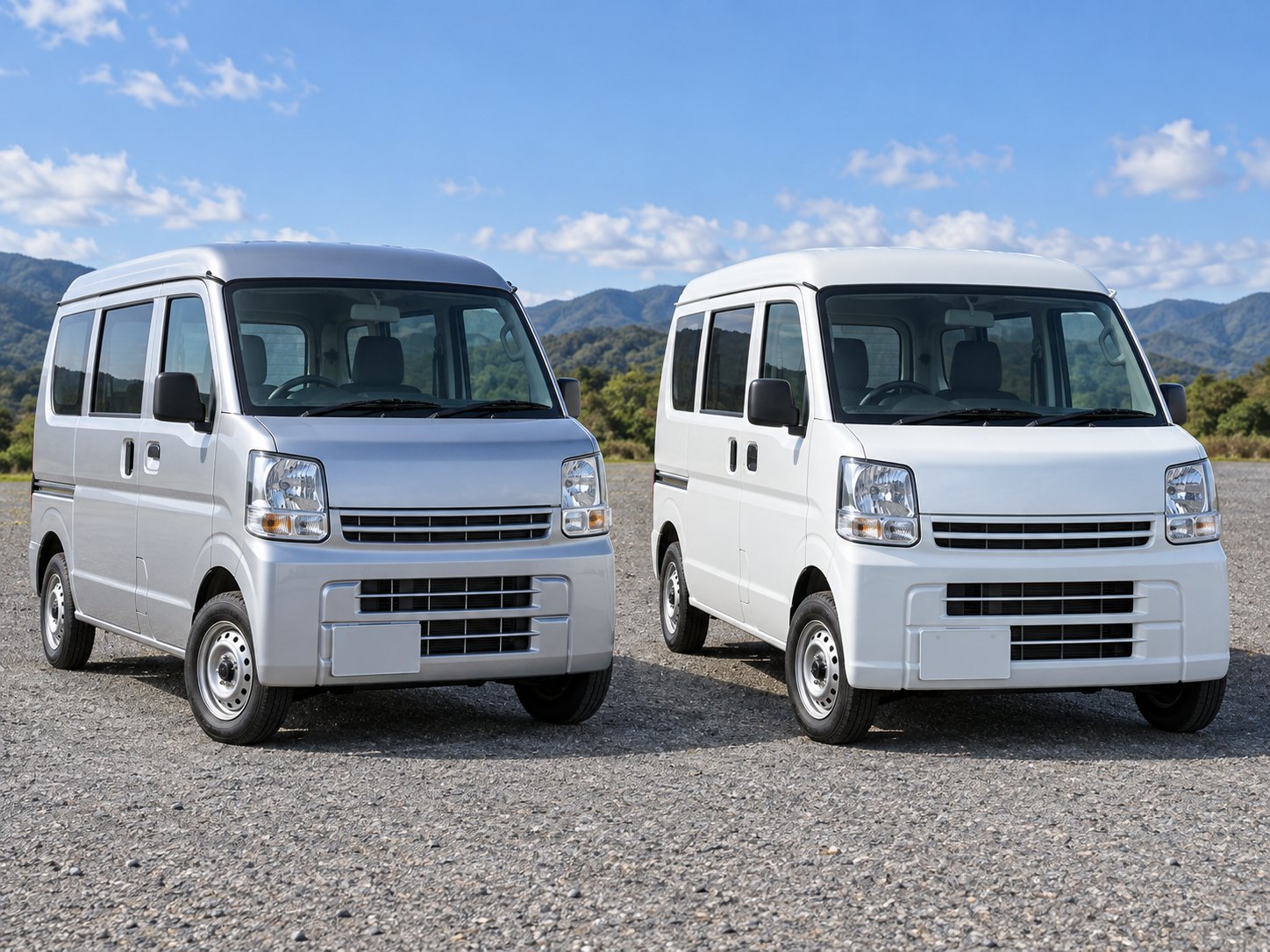
Different names, shared vehicle families
Some kei vans are OEM models: one manufacturer produces the vehicle and another sells it under its own brand. Looking at sister models can broaden the choice of used vans that fit your equipment needs and budget.
The model codes below are representative examples. Codes and equipment vary with year, drivetrain and specification. Check the inspection certificate, chassis number, actual vehicle and part numbers when buying or ordering parts.
What is shared, and what can differ?
Basic structure may be shared, while badges, front-end styling, grade names, standard equipment, colours and sales periods differ. Being in the same family does not make every specification identical.
Main kei van families
| Base vehicle / supplier | Sister models |
|---|---|
| Suzuki Every | Mazda Scrum Van; Nissan NV100 Clipper; Mitsubishi Minicab Van. |
| Daihatsu Hijet Cargo | Toyota Pixis Van; Subaru Sambar Van. |
| Honda N-VAN | A separate design with no OEM sister model; not part of the Every or Hijet families. |
Every family: representative model codes
| Generation | Suzuki Every | Mazda Scrum Van | Nissan NV100 Clipper | Mitsubishi Minicab Van |
|---|---|---|---|---|
| DA64 family | DA64V | DG64V | DR64V — supplied by Suzuki from December 2013 | DS64V — Suzuki-supplied models in the later part of this generation |
| DA17 family | DA17V | DG17V | DR17V | DS17V |
The V suffix here represents commercial van examples. Wagon models, drivetrains and revisions require separate checks. Nissan Clipper previously belonged to the Mitsubishi Minicab family and switched to Suzuki supply in December 2013.
Comparable grade positions in the Every family
The following comparison centres on DA17-family used vans. It indicates broadly similar market positions, not identical equipment.
| Position | Suzuki | Mazda | Nissan | Mitsubishi | Typical focus |
|---|---|---|---|---|---|
| Base / work | PA | PA | DX | M | Essential equipment, purchase cost and work use. |
| Middle / daily convenience | PC | PC | DX GL Package | No independent direct equivalent; compare M and G | Windows, keys, mirrors and other everyday functions tend to be more equipped than base grades. |
| Upper naturally aspirated | JOIN | BUSTER | GX | G | Seats, rear-seat use, keys and interior comfort; work and everyday use. |
| Turbo | JOIN Turbo | BUSTER TURBO | GX Turbo | Bravo | Turbo engine and upper-grade equipment for hills, motorways and loaded work. |
Compare keys, power windows, electric mirrors and storage particularly when entering/exiting frequently. JOIN/BUSTER/GX/G often place greater emphasis on interior comfort such as fabric seats and rear-seat usability. A turbo may be hard to identify from appearance alone: check the grade, inspection certificate and engine specification. Consider purchase and maintenance costs as well as performance.
Safety features, transmissions, keys, rear seats and door closers vary with year, revision and 2WD/4WD. Similar grade names in present models and older DA17-family stock do not guarantee identical specifications.
Hijet Cargo family: representative codes
| Generation | Daihatsu Hijet Cargo | Toyota Pixis Van | Subaru Sambar Van |
|---|---|---|---|
| S300 | S321V / S331V | S321M / S331M | S321B / S331B |
| S700 | S700V / S710V | S700M / S710M | S700B / S710B |
Check the final letter as well as the numbers. Toyota has sold the Daihatsu-supplied Pixis Van since 2011. Subaru ended its own Sambar production in 2012 and moved to Daihatsu OEM models that year.
Comparable Hijet-family grades
In the S700V/S710V family, Daihatsu and Toyota share many grade names, while Subaru uses its own names.
| Position | Daihatsu | Toyota | Subaru | Typical focus |
|---|---|---|---|---|
| Base / cargo and work | Special | Special | VB | Simple trim and cargo usefulness, with cost and loads prioritised over passenger comfort. |
| Clean specification | Special Clean | Special Clean | VB Clean | An emissions-related specification; assess the relevant model year and use. |
| Middle / equipment and cargo | Deluxe | Deluxe | Transporter | More equipment such as overhead shelf and seat trim, while retaining practical load-carrying features. |
| Upper naturally aspirated | Cruise | Cruise | VC | Comfort equipment such as split rear seats, glazing and air-conditioning features; cargo dimensions differ from lower grades. |
| Turbo | Cruise Turbo | Cruise Turbo | VC Turbo | Cruise-family comfort equipment combined with a turbo engine. |
| Subaru-specific upper specification | No same-name direct equivalent | No same-name direct equivalent | Dias | An upper specification also aimed at leisure use; not a simple one-to-one match. |
With two occupants, S700 Deluxe/Special versions have a longer cargo area than Cruise variants. Cruise emphasises split rear seats and passenger comfort. Compare Deluxe for tools, long items and useful equipment; compare Cruise for rear seats, glass and comfort features. Turbo versions merit consideration for motorways and heavier loads, while naturally aspirated versions may suit shorter trips and a lower purchase budget.
Even matching grade positions can differ in safety packages, audio, power sliding doors, colours and options by brand and year.
How the supply relationships changed
| Date | Event |
|---|---|
| October 2003 | Mitsubishi began supplying Nissan Clipper, then based on the Minicab commercial kei vehicle. |
| December 2011 | Toyota launched Pixis Van as its second phase of Daihatsu-supplied kei vehicles. |
| 2012 | Subaru ended its own kei production in February; the new Sambar launched in April was supplied by Daihatsu. |
| December 2013 | Nissan NV100 Clipper changed to Suzuki OEM supply. |
| 2015 | Every moved to the DA17V generation, with related Scrum, NV100 Clipper and Minicab versions. |
What can differ between an OEM van and its base vehicle?
- Appearance: badges and, depending on year, grilles and bumpers.
- Grades/equipment: names, standard equipment, factory options and colours.
- Timing: launches and revisions are not always simultaneous; check model code as well as registration year.
- Parts: many are shared, but exterior, electrical and specification-specific parts are not universally identical. Match chassis and part numbers.
Advantages and cautions when buying used
Considering several names increases your options and helps you compare price, equipment and condition within a vehicle family. An OEM model is not necessarily cheaper. Do not infer features from the grade name alone; compare the year, code, drivetrain, actual condition, warranty, maintenance records and total price.
At iWorks we put vehicle condition, history, necessary equipment and running costs ahead of the badge. We can search across sister models to find a van that fits your work.
Before-purchase checklist
- Vehicle name, complete model code and first registration date on the inspection certificate.
- 2WD/4WD, transmission and engine specification.
- Safety and comfort equipment actually fitted.
- Structural repair history, service history and previous use.
- Cargo area, doors and underbody condition.
- Chassis-number confirmation for replacement parts.
Common questions
Are Every and NV100 Clipper the same?
In corresponding generations they are sister vehicles based on the same design, but year, grade, equipment and selling periods can differ. Check the model code and actual van.
Are Hijet Cargo and Sambar the same?
Sambar Vans from the 2012 change are Daihatsu-supplied Hijet-family models. Earlier Sambar models include Subaru’s own design.
Are all parts interchangeable?
No. Many are shared, but bodywork, electrics and grade-specific equipment can differ. Order by chassis number and part number.
Is the OEM version cheaper?
Recognition and market supply can affect prices, but there is no guarantee. Compare condition, equipment, service history and total purchase cost.
Tell us how you will use your van
iWorks is a kei van specialist in Midori Ward, Nagoya. We can help you compare vehicles around your work, budget and equipment, with advice from sales and our certified maintenance workshop. Some vehicles are not listed online. Contact us even if you have not chosen a model.
Browse current stock on Goo-net (Japanese) · Contact us on LINE · Call 052-602-7204
Prices and availability change. Confirm the current listing and your individual quotation.
Alongside Every, Hijet Cargo and N-VAN, we can include Scrum, NV100 Clipper, Minicab, Sambar and Pixis Van in your search.
Official reference material
The Japanese guide uses the following manufacturer material for supply history, model families and grade comparisons. For an individual van, verify its inspection certificate and actual equipment.
- Suzuki Every grades and equipment (Japanese)
- Mazda Scrum Van grades (Japanese)
- Nissan Clipper Van grades (Japanese)
- Mitsubishi Minicab Van grades (Japanese)
- Daihatsu Hijet Cargo grades (Japanese)
- Toyota Pixis Van grades (Japanese)
- Subaru Sambar Van grades (Japanese)
- Nissan/Mitsubishi supply announcement (Japanese)
- Nissan 2013 Suzuki-supplied NV100 Clipper (Japanese)
- Toyota Pixis launch (Japanese)
- Subaru 2012 Sambar launch (Japanese)
- Subaru end of own kei production (Japanese)
- Mazda 2015 Scrum Van model change (Japanese)